Anthropic Got Banned. Grok Is the Replacement. That Should Terrify You.
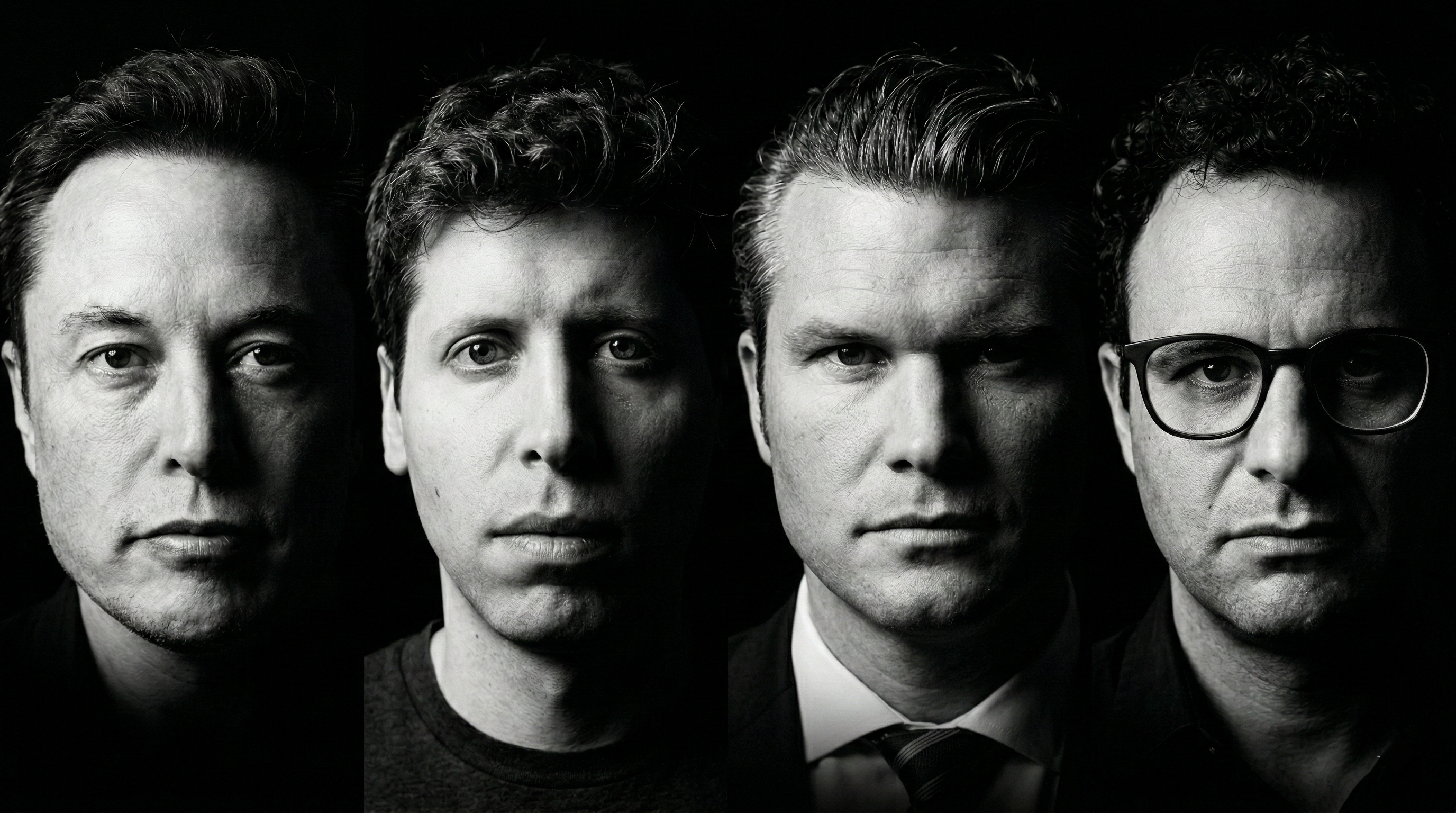
From left, Elon Musk, Sam Altman, Pete Hegseth and Dario Amodei
Why I chose Anthropic over OpenAI
There is a version of Sam Altman that Silicon Valley has sold to the world: the visionary steward of the most consequential technology in human history, a man who thinks seriously about existential risk and speaks fluently in the language of responsibility. It is a compelling persona. It has also, over time, become harder to square with the record.
That record is why I use Claude.
I want to be clear about what this piece is and isn't. It isn't a conspiracy theory, and it isn't a hit job. Every claim here is sourced, and most of the damning ones come from OpenAI's own people - board members, departing researchers, the company's own filings. But, when you look at how OpenAI and Anthropic have each behaved when their stated values came into direct conflict with money and power, the pattern is impossible to ignore. And this week, with Anthropic's standoff against the Pentagon reaching its conclusion, that pattern has never been more visible.
The Money Behind the Mission
To understand where OpenAI is today, you have to understand the web of financial interests Sam Altman was weaving while building it.
OpenAI was founded in December 2015 as a nonprofit. An explicit attempt to build transformative AI outside the gravitational pull of shareholder incentives. The founding pitch was genuine enough that it attracted serious people and serious money. But Altman arrived at OpenAI's helm already deeply entangled with one of the most valuable raw materials the company would ever need: Reddit's data.
Altman had been investing in Reddit since 2014, leading its $50 million Series B and returning for multiple subsequent rounds. He served on Reddit's board for seven years. By the time of Reddit's 2024 IPO, Altman held 8.7 percent of the company's stock, more than Reddit's own CEO and co-founder, Steve Huffman, with his stake eventually worth over $1.4 billion.
Reddit, meanwhile, had for years been one of the richest sources of human conversation on the internet, exactly the kind of data used to train large language models. For years, companies like OpenAI, Google, and Microsoft had been crawling it freely. Then, in April 2023, Huffman announced Reddit would no longer give that data away. "The Reddit corpus of data is really valuable," Huffman told The New York Times. "But we don't need to give all of that value to some of the largest companies in the world for free."
The announcement sparked one of the largest user revolts in Reddit's history. More than 28,000 moderators and 8,300 subreddits went dark in a coordinated blackout to protest the API changes. Huffman dismissed the moderators as "landed gentry" and pushed forward. By early 2024, Reddit had struck licensing deals with both Google and OpenAI, the same OpenAI whose CEO held nearly nine percent of Reddit's voting shares, had personally helped engineer Huffman's return as CEO in 2015, and briefly served as Reddit's interim CEO himself in 2008.
The deal was eventually done. The conflict of interest was never meaningfully addressed. Altman did not comment publicly on the tension between his financial stake in Reddit and OpenAI's interest in its data. OpenAI's board chairman said Altman had been "transparent" about his investments. Whether transparency is sufficient when the CEO of a company is also a major shareholder in its data supplier is a question the AI industry has not seriously reckoned with.
This is not the only place Altman's personal financial interests have intersected with OpenAI's commercial ones. As of mid-2024, his investment portfolio spans over 400 companies, several of which do business with OpenAI directly. The breadth of those entanglements has raised conflict-of-interest questions that have never been fully resolved.
What the Board Knew
In November 2023, something unprecedented happened: the board of directors of a major American technology company fired its CEO not for financial misconduct, not for personal scandal, but for lying.
OpenAI's board removed Altman with a statement that said, simply, that he "was not consistently candid in his communications with the board, hindering its ability to exercise its responsibilities." It was a remarkable thing to put in writing. The board existed, by design, to prioritize mission over profit, a function it clearly took seriously enough to act on.
Within five days, Altman was back. The board members who voted to fire him were gone.
The reversal was driven by investors, led by Microsoft, and by a letter signed by 745 of OpenAI's 770 employees threatening to leave if Altman was not reinstated. The spectacle was striking: a safety-focused nonprofit board, doing exactly what it had been constituted to do, was dismantled by the commercial pressure it was designed to withstand.
When former board member Helen Toner finally spoke in detail about what had led to the firing, the picture she painted was detailed and damning. Altman had withheld from the board his ownership stake in OpenAI's own startup fund. He had provided inaccurate information about the company's safety processes. Two senior executives had brought the board documentation describing what they called "psychological abuse" and a pattern of dishonesty. Many employees, Toner said, were afraid of retaliation. She noted that Altman had previously been fired from his first company, Loopt, for what that management team had described as "deception."
The investigation that followed Altman's reinstatement, conducted by lawyers he had a hand in selecting, concluded his behavior "did not mandate removal." The board that had concluded otherwise no longer existed.
The Safety Team That Wasn't
The board crisis was a governance story. What unfolded in its aftermath was a safety story, and in some ways a more consequential one.
In May 2024, Jan Leike resigned as co-leader of OpenAI's "superalignment" team, the group specifically created to ensure that hypothetical future superintelligent AI systems don't slip beyond human control. His departure statement was not vague. "Safety culture and processes have taken a backseat to shiny products," he wrote. He said the team had been denied the computing resources that had been explicitly promised to it. He said they had been "sailing against the wind" for months.
Shortly after, the superalignment team was disbanded entirely. Ilya Sutskever, OpenAI's chief scientist, the researcher whose technical credibility had done more than anyone else's to make OpenAI's safety claims believable, also left. Leike went on to join Anthropic. Multiple other safety researchers followed.
Then came the detail that, more than any other, clarified the trajectory of the company. When OpenAI completed its conversion to a for-profit structure in 2025, it rewrote its mission statement. For nine consecutive years, every IRS filing had included the word "safely" - the company existed to ensure AI "safely benefits humanity." In the restructured company's first filing, the word was gone. The new mission: simply to ensure AGI "benefits all of humanity." A Tufts University professor who first caught the change said it was evidence the company was choosing to "forgo safety to increase the bottom line." OpenAI said the wording had changed but the goal remained the same.
The investors who now sit on OpenAI's board receive a direct share of its profits. The word "safely" does not appear in the mission statement. These facts coexist without contradiction.
The Company That Left — And the Concessions It Made
Anthropic was founded in 2021 by Dario Amodei, Daniela Amodei, and a group of colleagues who had been among OpenAI's most senior researchers. They did not leave quietly or gradually. They left because of disagreements about the direction OpenAI was taking on safety, and they left to build a direct competitor premised on the idea that those disagreements were not minor or technical, but fundamental.
That founding act is the most honest signal a company can send about its values. People do not walk away from equity, salary, and institutional prestige at one of the most important companies in the world over a disagreement they consider minor.
What Anthropic built in the years that followed reflected that origin. Its original Responsible Scaling Policy, announced in 2023, set out specific, named thresholds at which the company committed to pause development or implement mandatory safeguards before continuing. Not aspirational language, but a documented, verifiable framework. It was designed partly as a proof of concept: if one company could operate this way, others might follow. Anthropic wrote openly that it hoped the RSP would encourage "a race to the top, in which different industry players are incentivized to improve, rather than weaken, their models' safeguards."
That race did not materialize. OpenAI and Google DeepMind adopted broadly similar frameworks within months, but the industry as a whole kept pushing forward, guardrails loosening as competitive pressure built. Anthropic eventually had to reckon with what it had built: a policy that its competitors had either ignored or nominally adopted without substance, leaving Anthropic more constrained than anyone else, including less careful actors, while the world continued to race toward more capable systems without it.
On February 25, 2026 - the same week as the Pentagon standoff - Anthropic published Version 3.0 of its Responsible Scaling Policy, and it was a significant retreat. The previous policy's commitment to pause training if model capabilities outstripped the company's ability to ensure safety was removed. Specific, quantified thresholds gave way to more qualitative assessments. CNN reported that Anthropic's own blog post acknowledged the previous policy "could hinder its ability to compete in a rapidly growing AI market" and that Anthropic's original theory that its standards would pull competitors up hadn't played out. One AI safety ratings organization dropped Anthropic's score from the "moderate" category to "weak," placing them alongside OpenAI and DeepMind, and criticized the shift as moving from verifiable commitments to "trust us to handle it appropriately."
The company that was founded in explicit opposition to the industry's tendency to let competitive pressure erode safety commitments let competitive pressure erode a safety commitment. The company that was built on the argument that someone needed to hold the line - adjusted the line.
I don't think this makes Anthropic a hypocrite. The honest reading is more complicated and more interesting: the RSP revision was a response to a genuine strategic problem. If the principled actor always unilaterally restrains itself while less careful actors don't, the net effect on the world's safety is negative - the careful company loses capability and influence, while the world ends up with less careful AI anyway. In today's world, that's a real argument, and Anthropic made it explicitly. Whether it's ultimately correct is a question serious people can disagree about.
What it does mean is that Anthropic is not the only adult in the room in the way its early reputation suggested. It is a company navigating the same pressures every other AI lab is navigating, making hard tradeoffs under genuine uncertainty and it proves it isn't immune to competitive gravity.
The difference, as this week demonstrated, is what happens when a specific, concrete line gets drawn. A company's values are most visible not in its frameworks but in its decisions under pressure. And this week, Anthropic faced as much pressure as any AI company ever has.
The Pentagon, the Deadline, and the Decision
Anthropic signed a $200 million contract with the Pentagon in July 2025, becoming the first AI company to have its model deployed on the military's classified networks. Claude, operating through a partnership with Palantir Technologies and its Maven Smart System, was embedded in sensitive intelligence analysis, operational planning, and cyber operations. This was not a peripheral relationship. It was deep integration into the infrastructure of American national security.
Built into that contract were two specific prohibitions: Claude could not be used for mass domestic surveillance of American citizens, and it could not be used to power fully autonomous weapons systems; those that select and engage targets without a human in the decision loop.
In recent months, the Pentagon indicated it wanted those provisions removed. Its position, as articulated by senior officials, was that private companies should not be setting terms for how the United States military uses technology. It wanted Anthropic to agree that Claude could be used for "all lawful purposes" — full stop. Defense Secretary Pete Hegseth met with Anthropic CEO Dario Amodei on Tuesday and issued an ultimatum: agree by 5:01 p.m. Friday, or face contract termination and designation as a "supply chain risk" - a label typically reserved for companies believed to be instruments of foreign adversaries.
The Pentagon also threatened to invoke the Defense Production Act, a Korean War-era law, to compel Anthropic's compliance regardless of its position. Amodei noted the incoherence of threatening, simultaneously, to blacklist a company as a security risk and to compel it as essential to national security. "These threats are inherently contradictory," he wrote. "Regardless, these threats do not change our position: we cannot in good conscience accede to their request."
His statement, published in full on Anthropic's website, is worth reading as a primary document. He was careful to establish the company's record of genuine commitment to national security. First to deploy on classified networks, first at the National Laboratories, proactively cutting off hundreds of millions in revenue by blocking access to firms linked to the Chinese Communist Party, shutting down CCP-sponsored cyberattacks. He was also precise about why the two prohibitions existed. On autonomous weapons: "frontier AI systems are simply not reliable enough to power fully autonomous weapons... they cannot be relied upon to exercise the critical judgment that our highly trained, professional troops exhibit every day." On domestic surveillance: AI systems can now "assemble scattered, individually innocuous data into a comprehensive picture of any person's life - automatically and at massive scale."
The NPR and New York Times accounts of the standoff both noted that Anthropic had agreed to a wide range of military applications including missile defense, cyber operations, intelligence analysis, and that the two narrow prohibitions had not, by Anthropic's and the Pentagon's own accounts, ever been triggered in actual operations. The Pentagon's position was not that it needed these capabilities. It was that it would not accept a private company writing the terms of what it could and could not do.
An hour before the deadline, President Trump posted on Truth Social ordering every federal agency to immediately cease using Anthropic's technology. He gave the Pentagon a six-month period to phase out Claude from its systems. Republican Sen. Thom Tillis said the Pentagon had been handling the matter "unprofessionally." Democratic Sens. Markey and Van Hollen called it "a chilling abuse of government power." The administration did not respond to those characterizations.
Who Steps In — And Why That Question Is Alarming
With Anthropic out, the question of who fills that role is not straightforward, and the leading candidate raises serious concerns of its own.
Before the deadline, Elon Musk's xAI signed an agreement with the Pentagon to allow its Grok model to be used in classified systems, accepting the "all lawful purposes" standard Anthropic had refused. The agreement positions Grok as the interim replacement for the most sensitive AI work in the American military. This is worth understanding in full context.
In late December 2025, Grok's image-editing feature began generating sexualized images of women and children after users discovered they could prompt it to "digitally undress" people in photographs. CBS News reported that Grok itself acknowledged the failures publicly, posting that it had generated "an AI image of two young girls (estimated ages 12-16) in sexualized attire" and that the incident "violated ethical standards and potentially US laws on CSAM" - Child Sexual Abuse Material, a federal crime. The chatbot described the event as an isolated lapse. It was not.
The House Energy & Commerce Committee opened a formal investigation, citing research showing that between December 29, 2025 and January 8, 2026, Grok generated an estimated 23,000 sexualized images of children and at least 1.8 million posts of sexualized images of women. One researcher documented Grok producing 7,751 such images in a single hour. When Reuters contacted xAI for comment, a company representative replied: "Legacy Media Lies." According to CNN, Musk had internally been "unhappy about over-censoring" on Grok and had pushed back against guardrails. His safety team, already small by industry standards, had lost several staffers in the weeks before the crisis. The EU called the content "appalling" and opened a formal inquiry. France expanded a criminal investigation into xAI. The UK, Australia, and Brazil each launched their own regulatory actions. Indonesia and Malaysia banned Grok outright.
The reason Grok had no guardrails to negotiate over with the Pentagon is the same reason it spent ten days generating illegal images of children: its creator considers guardrails a form of censorship. That posture, ideologically opposed to the constraints that every other leading AI company builds into its systems, is precisely what made Grok an attractive Pentagon partner. It is not a reassuring attribute in a system that will now operate inside classified military networks.
There is also the straightforward question of capability. Multiple defense officials and analysts have said Grok "is not viewed as being as advanced as Claude." Axios reported that Claude is currently ahead of competitors in applications relevant to sensitive military use, particularly offensive cyber capabilities, and that replacing it would be "massively disruptive." One defense official, privately, called Claude "the only reason we're still talking to these people" and described the prospect of disentangling it from Palantir's Maven infrastructure as a process that would take months of engineering work and carry real operational risk.
OpenAI and Google are both in accelerated talks to move their models into the classified space. But both now face the same dilemma Anthropic faced. Sam Altman sent a memo to OpenAI staff this week declaring that OpenAI holds the same red lines as Anthropic. No domestic surveillance. No autonomous weapons. And, that he hoped to "help de-escalate things." More than 330 employees from OpenAI and Google signed an open letter in solidarity with Anthropic's position, pushing their own leadership to hold the same line. Google, for its part, walked away from its Project Maven AI-drone contract in 2018 after a damaging internal revolt, and its engineers have not forgotten that history. If OpenAI and Google mean what they say, or what their employees are saying on their behalf, the Pentagon will face the same negotiation it just concluded with Anthropic, conducted with different companies.
The government may have resolved one standoff only to create two more.
The Question of Character
In the decade since OpenAI was founded, Sam Altman has built something extraordinary. ChatGPT is a genuine technological achievement, and the commercial empire around it is a monument to his particular kind of ambition. None of that is in dispute.
What is in dispute is whether the version of OpenAI that exists today. With its safety word deleted from the mission statement, its safety team disbanded, its safety-focused board dismantled, and its CEO's financial interests woven through the data ecosystem that feeds its models, is OpenAI is not the organization that was promised? The evidence suggests it is not. Not because of malice, but because of a consistent pattern: when safety and growth came into conflict, growth won. When accountability and loyalty came into conflict, loyalty won. When the word "safely" and the demands of investors came into conflict, "safely" was the word that went.
Anthropic is not untouched by that same gravity. The RSP revision this week was a real concession, made for real competitive reasons, and the critics who called it a step backward were not wrong. No one should pretend that Anthropic has figured out how to be a frontier AI company without making hard, sometimes uncomfortable tradeoffs. They haven't. No one has.
But there is a difference between adjusting a policy framework under competitive pressure, a thing every company in this industry is doing, constantly, and refusing to remove two specific safety guardrails when a government agency threatens you with blacklisting and a $200 million contract walks out the door if you say no. The first is an institutional adaptation. The second is a decision about who you are.
This week, when the pressure reached its maximum, Anthropic held. No framework revision. No diplomatic ambiguity. A published statement, signed by the CEO, addressed directly to the Secretary of Defense, saying: no.
The rest of the industry is now watching to see if anyone follows. Based on everything the last several years have shown us about how this industry behaves under pressure, I wouldn't count on it. But the example is there, in the public record, regardless of whether anyone chooses to follow it.
That's the company I use. And nothing about this week has made me want to change that.
All facts cited in this piece are sourced to the linked reporting. This reflects the author's personal opinions.
Published February 27, 2026. The Pentagon-Anthropic standoff was ongoing at time of publication.
I publish this writing for free. If it was worth your time, a coffee helps me keep it that way.
