The Court Just Said AI Can't Own Art.
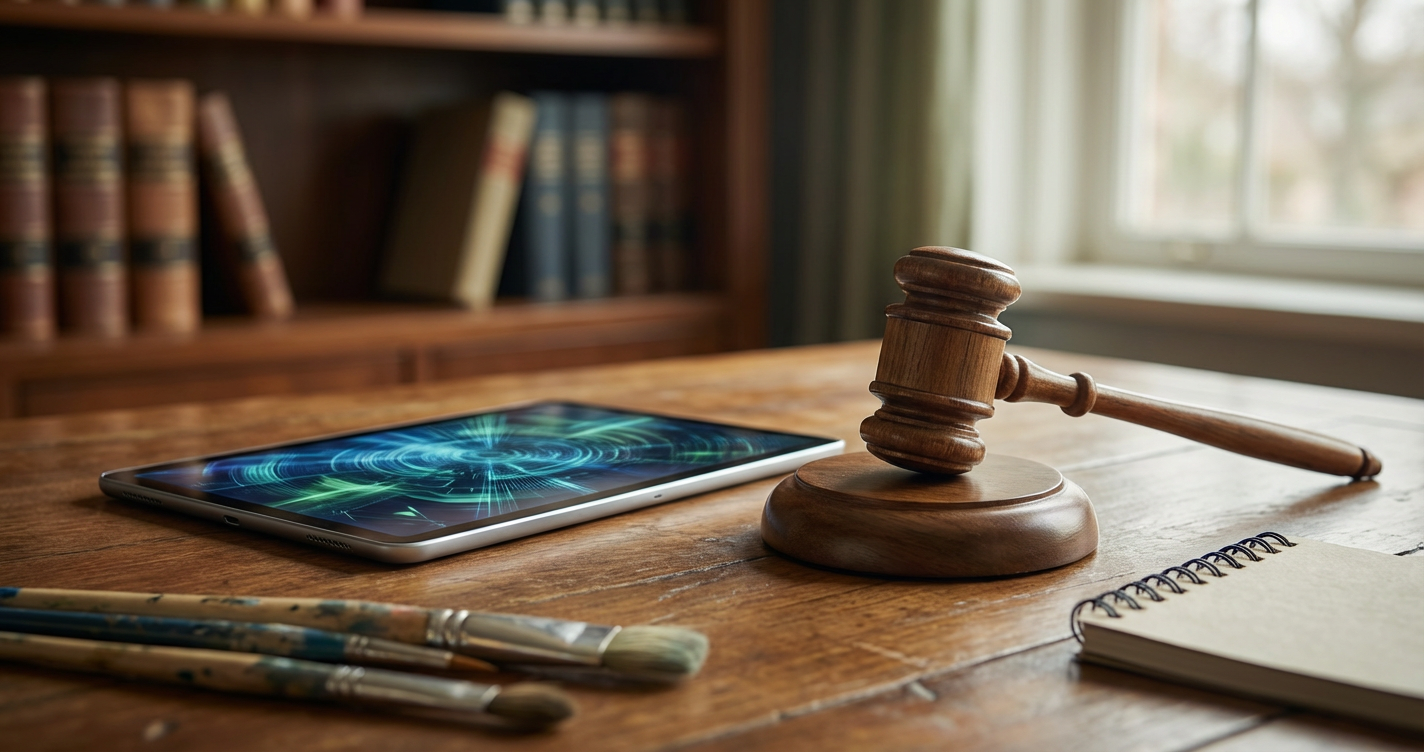
A digital conceptualization representing the intersection of artificial intelligence and the legal boundaries of human creativity.
On March 2, 2026, the U.S. Supreme Court declined to hear Thaler v. Perlmutter. No dramatic ruling. No landmark opinion. Just a denial of certiorari. Letting the lower court decisions stand without a word. The result: AI-generated art cannot be copyrighted. Not by the AI. Not by the person who owns it. Not by anyone, if no human was meaningfully in the creative driver’s seat.
For anyone who has ever devoted serious time to an artistic craft, this is worth caring about.
What Actually Happened
In 2018, computer scientist Stephen Thaler applied for a copyright on a piece of visual art he said was created entirely by his AI system, DABUS. He was honest about it. No pretense that a human hand guided the output. The machine made it. He wanted the machine, or himself as its owner, to own the rights.
The Copyright Office said no. Federal courts said no. The Supreme Court, on March 2nd, declined to say anything at all. Which, in practice, means no.
The legal logic has been consistent at every level, across four years and three courts, with not a single ruling going the other way. Human authorship is a "bedrock requirement" of copyright law. The D.C. Circuit affirmed it. The Supreme Court, by refusing to intervene, let it stand.
The Copyright Office's January 2025 report on AI and copyright made this point even clearer by stating that entering a prompt doesn’t make you the author of the output. If an AI is determining the expressive elements, then no copyright attaches to the result.
Why I Think This Is Right. And Why It’s Also Complicated.
I’ve spent years in photography and digital art, and I’ve even worked in the TV and film industry. My family still does to this day (though not as much as they used to, for dozens of reasons, including job losses to AI). For me, learning about light, composition, having patience to wait for the right moment, and the technical discipline to execute when it arrives was not always easy or without trial. And the craft means a lot to me. For the creators of AI, it reminds me of a comment I used to hear all the time: "that's a really nice camera, I bet it takes great pictures" - Well, yes... But I am the one holding the camera.
But I’ve also used AI-generated art. On this site (see cover image). In other projects. So I’m part of the problem I’m describing, and I know it. To me, acknowledging this tension is more useful than pretending it doesn’t exist. It helps pave the way to a meaningful resolution.
It should be painfully obvious by now that AI-generated art disproportionately displaces human-powered creative work. Concept artists, illustrators, stock photographers - people who built careers, are now watching those careers get commoditized at a speed the industry wasn’t ready for. It’s not hypothetical. It’s happening now. My family and dozens of others in the industry I know have lost their careers and so much more. It will keep happening. It will not stop.
Against this backdrop, the Supreme Court ruling, or perhaps lack thereof, matters. Not because it prevents AI art, but because it refuses to grant it legal protection. Fully AI-generated work enters the public domain the moment it's made. Anyone can use it. No one can lock it down.
For human artists, the distinction isn’t trivial. The works of painters, photographers, digital artists, sketch artists, and more, that are shaped by genuine human creative decisions, retain something that AI output fundamentally cannot: legal authorship. Copyright. Ownership.
The Part Nobody Wants to Talk About
The Copyright Office's framework isn’t a binary. Pure AI output gets no copyright. Pure human work gets full copyright. Everything in the middle depends on the specifics, and nobody has fully mapped it yet. It seems like a dubious area that no one wants to get close to - at least right now.
If a human makes “sufficiently creative” arrangements or modifications of AI-generated material, those contributions may be protected. If original human work is perceptibly embedded in an AI output, copyright may attach to those elements. What does that look like in practice? One can hope that litigation will sort it out over the next decade. But by then, the damage is already done.
And this ruling doesn’t touch on larger questions. AI systems trained on copyrighted work without permission. Visual likeness. Major studio franchises, iconic characters, and the entire entertainment industry’s exposure. The Copyright Office’s Part 3 report, which focuses specifically on training data and licensing, is still pending. When this report drops, I imagine that this is where things could get genuinely explosive.
This ruling was narrow. The road ahead is not.
What We Owe Each Other Now
AI tools aren’t going away. I use them. Most people creating content online do, or will. The question now isn’t whether AI exists in the creative process. It’s whether we’re honest about its role.
The court’s ruling at least gives us a legal framework for that honesty. Work that a human genuinely authored is protected. Work a machine generated isn’t. Claiming otherwise is both legally wrong and a failure of integrity (though the notion that integrity still exists today seems fleeting).
I’ve never claimed the AI-generated images or content I’ve used as my own. They’re tools, the same way a stock photo is a tool. That line matters to me. Not because the law required me to draw it, but because I know what it actually took to learn how to make true art. An AI prompt isn’t that. AI isn’t art - merely an abstraction of it.
The ruling affirms the distinction. It doesn’t solve the displacement problem. It doesn’t restore the careers already affected.
But it says, clearly: authorship still means something. It still requires a human.
Sources: Reuters · CNBC · artnet News · Holland & Knight · IPWatchdog · U.S. Copyright Office AI Report Part 2 · Boing Boing
I publish this writing for free. If it was worth your time, a coffee helps me keep it that way.
